Advice about not touching switches with wet hands is not wrong, but it is not where domestic electrical risk actually lives. The incidents that hurt people and damage homes come from a much smaller set of causes: heat at connections, missing earth leakage protection, water reaching places it should not, and warning signs that were ignored.
This is what genuinely matters, ordered roughly by how much difference it makes.
Test your RCCB every few months
If your board has an RCCB, it has a test button. Press it. The device should trip instantly and decisively. Push it back on and you are done — the whole thing takes ten seconds.
This matters more than anything else on this page, because a failed RCCB gives no outward sign. The board looks identical whether the device works or not, and you will only discover the difference during an actual fault. If it does not trip on test, have it replaced.
No test button anywhere on your board?
Then you have no earth leakage protection at all. Adding an RCCB is a half-day job and it is the single most worthwhile safety upgrade to an older installation.
Take warmth and smell seriously
Electrical fires almost always announce themselves before they start. The usual sequence is a loose connection, then heat at that connection, then discolouration of the plastic around it, then a smell, then a fire. There is usually weeks or months between the first step and the last.
So make a habit of noticing. A socket that is warm behind the TV unit. A switch plate that has gone slightly brown around one screw. A faint hot-plastic or fishy smell near the board that comes and goes. None of these are emergencies today; all of them are the early stage of something that will be.
- Warm socket or switch plate — stop using that point and get it checked
- Brown or yellow staining around pin holes — the same
- Fishy or hot-plastic smell — that is overheating insulation, act on it
- Buzzing or crackling from a switch or the board — a worn or loose contact
- Visible scorch marks anywhere — switch that circuit off now
Respect the difference between a socket and an extension
Extension boards are for temporary, low-load use. A phone charger, a laptop, a table lamp — fine. A geyser, an induction hob, a portable heater or an air conditioner — not fine, and the reason is straightforward: every connection in the chain adds resistance, resistance makes heat, and the extension's own cable is usually thinner than the fixed wiring it is plugged into.
One extension plugged into another compounds all of this. If a high-load appliance lives permanently in a spot with no socket, the answer is to add a socket.
Keep water and electricity properly separated
In Surat's climate this is a bigger factor than it sounds. Humidity for much of the year, heavy monsoon rain, and balconies and terraces where outdoor points get splashed all add up to a lot of moisture-related faults.
Practical measures: keep outdoor and balcony points properly covered and rated for the position; do not leave indoor-rated string lights out through the rains; make sure bathroom fittings are suitable for the zone they are in; and never run an extension lead out through a window to a wet balcony.
Know where your main switch is
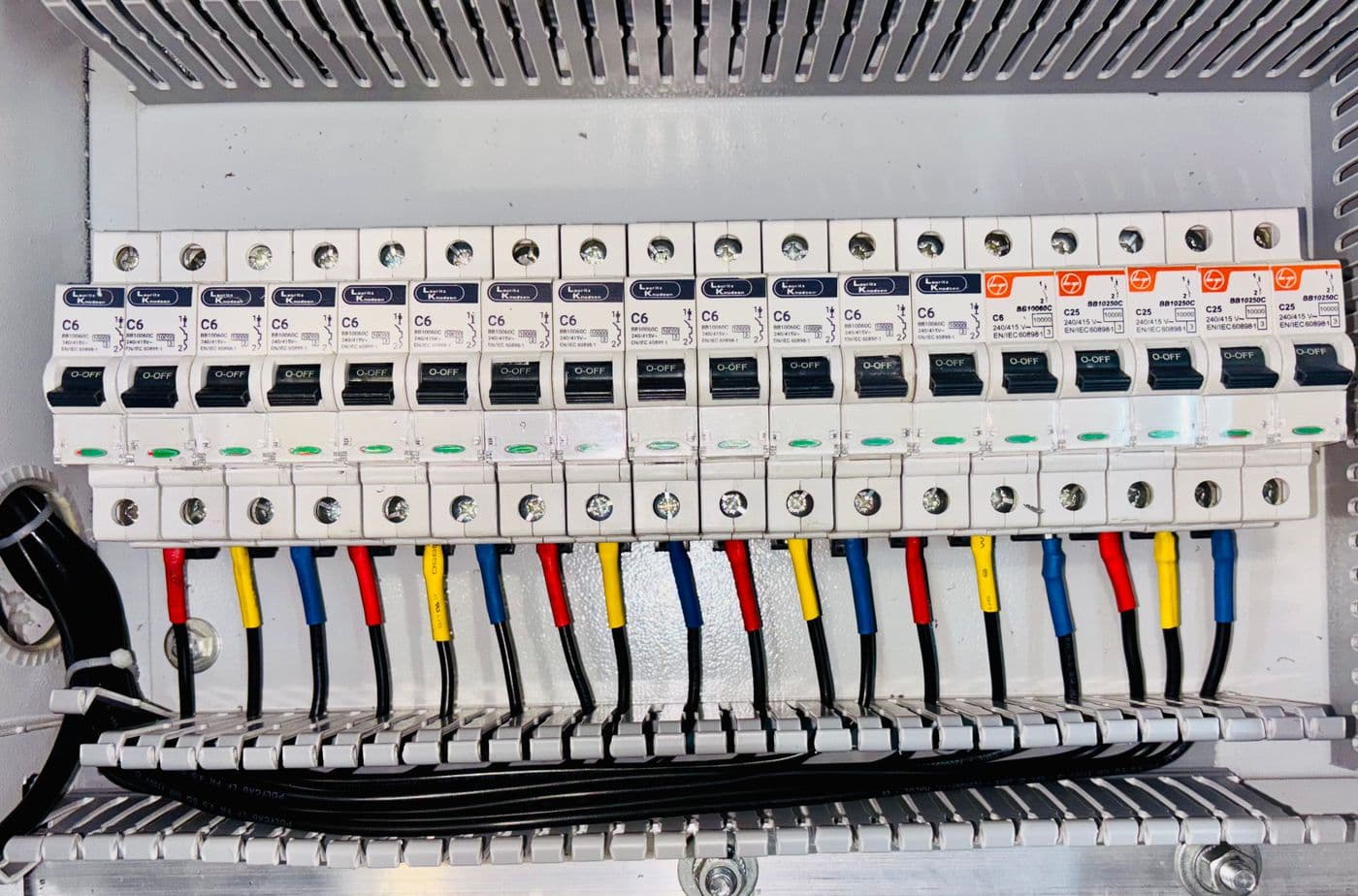
Everyone in the household who is old enough should know where the distribution board is and which switch kills the whole supply. In an emergency — a shock, a fire, water reaching a socket — the ability to isolate everything in three seconds is worth a great deal.
While you are there, check the board is actually labelled. If nobody knows which breaker controls which room, that is worth having sorted out; it is a quick job for an electrician and it saves a lot of confusion later.
Do not attempt work on live circuits
Changing a bulb is fine. Changing a switch, a socket or anything at the board is not a DIY job, and the reason is not just the shock risk — it is that a connection made incorrectly can look perfectly fine and cause a fire six months later.
If you do isolate a circuit to inspect something, switch off at the breaker rather than the wall switch, and verify it is actually dead before touching anything. Wall switches commonly interrupt only the live conductor, and sometimes they have been wired into the neutral instead — in which case the fitting is still live with the switch off.
Safety first
If you smell burning or see smoke from a board, socket or fitting: switch off the main supply, move everyone away, and do not switch anything back on until an electrician has inspected it.
Related service
Electrical Safety Inspection
A structured inspection of your board, earthing and circuits, with a plain-language report you can act on.
Quick answers
How often should I test my RCCB?
Every two to three months is a sensible habit. It takes ten seconds and it is the only way to know the device is still working.
Is it safe to use extension boards for air conditioners?
No. Air conditioners, geysers, induction hobs and heaters all need a dedicated point on a properly rated circuit. Extension leads are for temporary, low-load use only.